


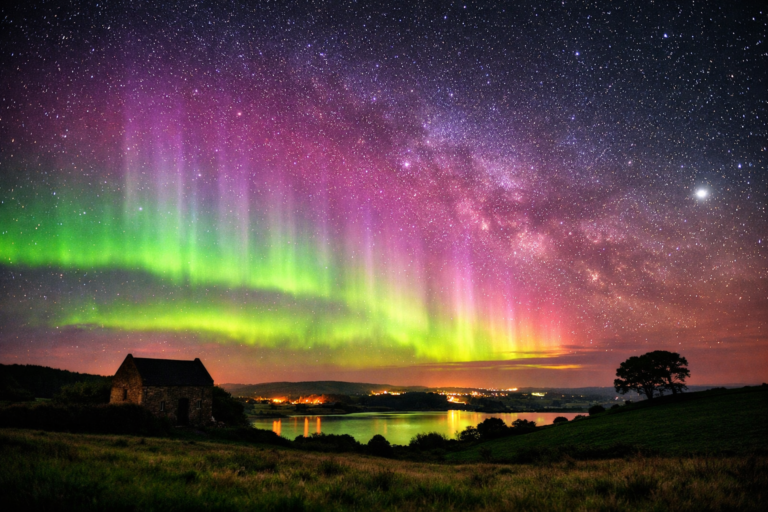
If you’ve ever looked at photos of the Northern Lights and thought, “I’ll never see that from here,” you might want to think again. Scientists say 2026 could be one of the best years yet to spot auroras, even from places like the UK.
Many people still remember the stunning scenes from November 2025, when the night sky suddenly lit up in glowing greens and purples. The rare display, shared widely by BBC Weather Watchers, was caused by a powerful solar flare erupting from the Sun. For many, it was their first real glimpse of the aurora without travelling north.
So, what’s going on with the Sun?
The Sun isn’t always this dramatic. It follows a regular 11-year activity cycle, moving between quieter periods and phases when sunspots and solar eruptions become more common. In October 2024, NASA confirmed the Sun had reached the peak of its current cycle.
That peak meant more solar flares and bursts of energy heading toward Earth through 2024 and 2025. While the X5.1 flare in November 2025 was the strongest that year, it was still smaller than the massive flares seen in May and October 2024.
Why 2026 still looks promising
Even though the Sun has now passed its peak, experts say things won’t calm down straight away. Solar activity fades slowly, and levels are expected to remain fairly high until at least 2026.
What that means in simple terms is this: it only takes one strong solar flare or coronal mass ejection to trigger a bright aurora. When the conditions are right, those colourful lights can stretch far beyond their usual polar homes.
There’s also a seasonal boost. During spring and autumn equinoxes, Earth lines up more favourably with the Sun’s energy. This alignment, known as the Russell–McPherron effect, almost doubles the chances of seeing auroras.
Technology is helping us spot more auroras
It’s not just space weather doing the work. Better forecasting, sun-monitoring satellites and smartphone cameras have made a huge difference. Faint auroras that might have gone unnoticed years ago can now be captured with a phone and shared instantly.
That’s why recent displays have been spotted as far south as Devon and Cornwall, something that would have sounded unlikely not long ago.
The light show isn’t over yet
When charged particles from the Sun collide with Earth’s atmosphere, they create the glowing ribbons of light we call the aurora borealis. With the Sun still fairly active, 2026 could offer several chances to see this natural spectacle without leaving the country.
For skywatchers, it’s a good reminder to keep an eye on space weather alerts and look up when the skies are clear. The next big display might be closer than you think.
FAQs
Solar activity remains high for years after its peak, making strong auroras more likely.
A powerful X5.1 solar flare sent energy toward Earth, lighting up the skies.
Yes, during strong solar storms, auroras can reach much farther south than usual.
It’s a seasonal alignment that increases the chances of auroras around the equinoxes.
The Sun is expected to reach its next minimum around 2031 to 2032.