

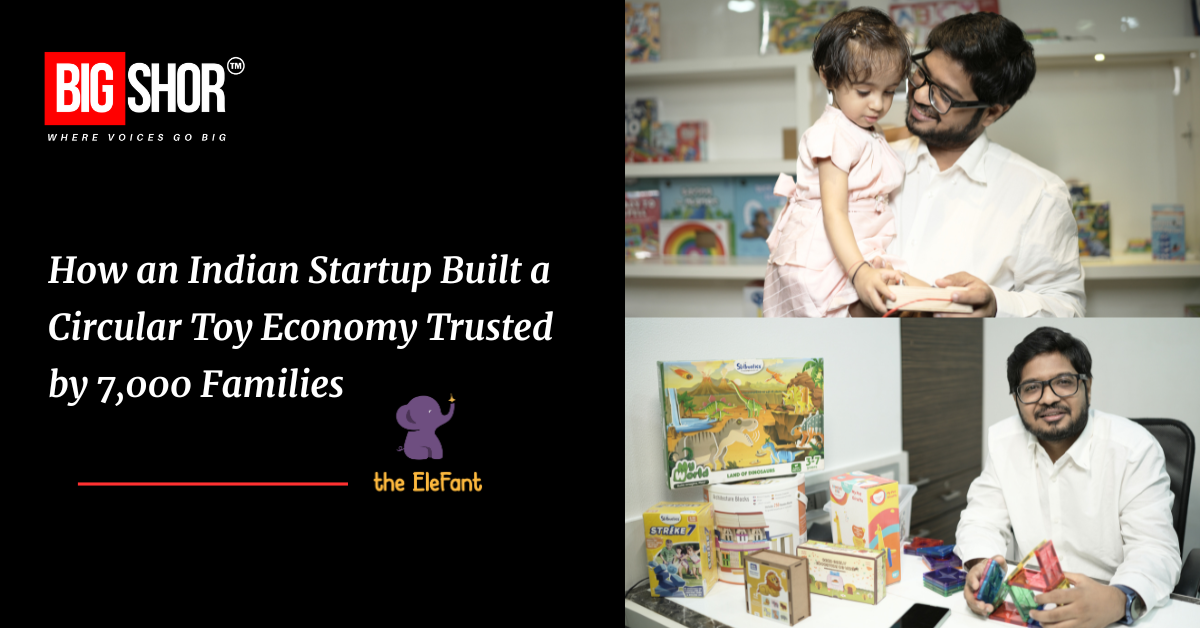
In 2021, when most young parents were worrying about screen time and overstimulated toddlers, Sourabh Jain was struggling with a problem closer to home: toys. Not the lack of them, but too many of them.
His daughter would adore a new toy for days, sometimes just hours, and then leave it untouched forever. Meanwhile, the pile of unused toys kept growing. The cost kept rising. And the environmental guilt kept deepening.
“It struck me that parents don’t actually need more toys. They need smarter ways to play,” Jain recalls. “Like books from a library or shows on Netflix, why couldn’t toys simply rotate?”
That insight led to the birth of EleFant, India’s first tech-enabled toy subscription platform. Today it is quietly building one of the most transformative consumer models in childcare.
A New Category in the Making: Play as a Service
EleFant allows parents to order, play, and swap premium development-focused toys anytime through a mobile app. Each toy is deep-cleaned, sanitized, quality tested, and recirculated from company-owned operational hubs, ensuring reliability and safety for children.
The experience is simple for parents but remarkably intricate behind the scenes. It involves logistics, sanitization standards, inventory rotation, personalization algorithms, and durability testing. Despite the complexity, EleFant has built the infrastructure with discipline and precision.
Today, EleFant operates:
- Across 18 cities
- Through 35 company-managed hubs
- Serving 7,000 plus families
- With full operational profitability (EBITDA positive)
In a subscription-driven economy where scale often comes at high cash burn, EleFant stands out for its unit economics discipline and operational efficiency.
The Impact That Goes Beyond Convenience
EleFant is not only making parenting easier but also reshaping the economics of play and consumption.
The platform has already:
- Enabled more than 1 million hours of playtime for children
- Saved families an average of ₹60,000 per year
- Prevented over 100 tons of plastic waste from reaching landfills
The company sits at the intersection of three rising consumer priorities in India: child development, conscious consumption, and convenience.
| Parent Concern | EleFant Solution |
|---|---|
| Kids get bored of toys quickly | Unlimited swaps |
| Toys are expensive | Subscription at a fraction of ownership |
| Homes get cluttered | Toys leave when new ones arrive |
| Sustainability matters | Circular reuse of toys |
EleFant has positioned itself not as a toy retailer but as a sustainability-first parenting service.
Trust as the Core Business Metric
To build a service embedded in family routines, EleFant made parental trust its primary KPI.
Rather than outsourcing logistics or relying on franchise models, the company built centrally controlled operational hubs. This decision allows standardization across:
- Product quality and condition
- Safety and sanitization protocols
- Delivery predictability
- Customer experience consistency
This operational control is not just a service choice. It is the foundation of EleFant’s defensibility.
From Personal Frustration to Scalable Movement
What began as a parent solving his own pain point is now shaping consumer behavior at scale.
Jain sums up the purpose with clarity:
“Every swap we enable saves a home from clutter, a parent from guilt, and a toy from ending up in a landfill. That is the change we are building one box, one child, one smile at a time.”
Looking ahead, the team aims to build the world’s largest play network, enabling learning to be accessible, homes to stay clutter-free, and play to become more meaningful for every child.
As India emerges as one of the youngest countries on the planet, demand for child development solutions is rising rapidly. EleFant is placing a strong bet on the future of parenting: not buying more, but playing smarter.
For thousands of families already on board, that shift is already underway.
About the Founder
Sourabh Jain
Founder and CEO, EleFant
A second-time entrepreneur driven by parent-inspired problem solving. His core belief: scale and sustainability can reinforce each other when the business model is designed for both.