
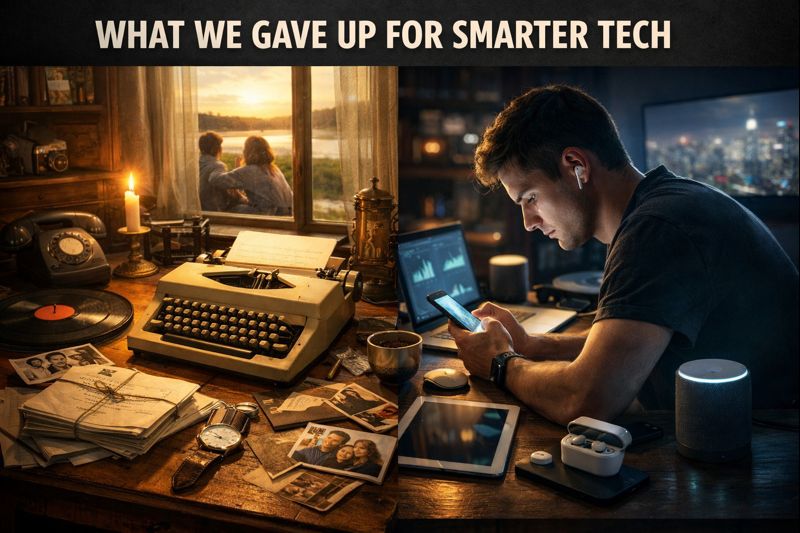
By the time your phone knows what you want before you ask, it has already learned something about you. The real question is what you gave up in return.
Not long ago, smart technology felt like a bonus. A navigation app that rerouted traffic. A recommendation that actually matched your taste. A device that turned on the lights before you stumbled into a dark room. It all felt helpful, almost magical.
Fast-forward to today, and smart tech is no longer a novelty. It is the default. Our phones unlock with our faces. Our watches track our heartbeats. Our homes listen, learn, and respond. Artificial intelligence writes emails, suggests friends, filters job applications, and even predicts illnesses.
But as technology got smarter, something else quietly faded into the background. We did not lose it overnight. We traded it away, feature by feature, update by update.
This is a story about what we gave up, often willingly, for convenience, speed, and intelligence.
Convenience Over Control
The biggest trade-off was control.
We used to decide. Now, algorithms suggest. What to watch. What to buy. What route to take. Even what words to type next.
At first, this felt like a relief. Fewer choices. Less mental effort. Who would not want help navigating an overwhelming digital world?
But over time, the suggestions became defaults. Autoplay replaced deliberate viewing. One-click purchases replaced thoughtful decisions. GPS replaced our sense of direction.
Studies now show that heavy reliance on automated systems can reduce our ability to make independent decisions. We are not incapable. We are just out of practice.
Smart tech did not take control from us. We handed it over because it made life easier.
Privacy Became the Price of Personalization
Personalization is the crown jewel of modern technology. Your feed feels tailor-made. Your ads are eerily relevant. Your apps know you.
But personalization runs on data, and lots of it.
To make technology smarter, we allowed it to observe us. Our locations, habits, preferences, conversations, and sometimes even our emotions. Over time, privacy stopped feeling like a right and started feeling like an inconvenience.
Terms and conditions grew longer. Consent became a checkbox we clicked without reading. Surveillance shifted from something we feared to something we normalized.
The result is a world where data is currency and individuals are the product.
While regulations have improved in some regions, data breaches, misuse, and opaque AI decisions remain common. Smarter tech did not just learn about us. It learned how much we were willing to give up.
Human Skills Took a Back Seat
Smart tools promised efficiency, and they delivered. But efficiency often came at the cost of human skill development.
Why memorize when you can search?
Why calculate when a calculator is faster?
Why write when AI can draft it for you?
Over time, reliance on smart tech reshaped how we learn and work. Skills like deep focus, critical thinking, handwriting, mental math, and even face-to-face communication began to decline in importance.
In workplaces, automation replaced repetitive tasks but also reduced opportunities for learning foundational skills. In schools, students gained access to powerful tools but lost patience for slow, complex thinking.
This does not mean technology made us less capable. It changed what we practice and what we neglect.
Attention Became the Battlefield
If data is the fuel of smart tech, attention is the prize.
Apps are designed not just to be useful, but to be irresistible. Infinite scrolls, push notifications, streaks, and algorithmic feeds all compete for one thing. Your time.
What we gave up here was subtle but profound. Our ability to be bored, to reflect, to sit with silence.
Moments that once invited daydreaming are now filled with screens. Waiting in line, commuting, and even conversations often include a quick glance at a phone.
Researchers link this constant stimulation to increased anxiety, reduced attention spans, and difficulty with deep work. Smarter tech optimized for engagement, not well-being.
We did not lose attention because we are weak. We lost it because the systems were designed to take it.
Ownership Turned Into Access
Once upon a time, we owned things. Music CDs. Software disks. Books. Cameras.
Today, we subscribe.
Streaming services, cloud software, AI tools, and digital platforms give us access but not ownership. Content can disappear. Features can change. Accounts can be suspended.
This shift made technology more flexible and affordable, but it also made users dependent. You do not control the product. You rent it under constantly changing rules.
Smart tech thrives on ecosystems, not independence. In exchange for seamless updates and cross-device syncing, we gave up permanence.
Work-Life Boundaries Blurred
Smart devices promised flexibility. Work from anywhere. Messages anytime. Productivity on demand.
But flexibility came with an unspoken expectation. Availability.
Emails followed us home. Notifications invaded weekends. Productivity tools tracked performance in real time. AI scheduling optimized every minute.
The boundary between work and life blurred, especially during and after the pandemic. Burnout rose. Rest became something we scheduled, if we remembered to.
Smarter tech did not create hustle culture, but it amplified it.
Trust Shifted From People to Systems
We once relied on people such as doctors, teachers, editors, and managers to make informed judgments.
Now, we increasingly trust systems.
AI flags resumes. Algorithms recommend sentences. Automated systems approve loans and assess risks. In many cases, we do not fully understand how these decisions are made.
This shift raises serious questions about accountability. When a system makes a mistake, who is responsible? The developer? The company? The algorithm?
Smarter tech earned our trust by being accurate most of the time. But blind trust comes with consequences, especially when systems inherit human biases.
So, Was It Worth It?
This is not a story of regret. Smart technology has brought real benefits. Accessibility, efficiency, medical breakthroughs, global connection, and creative tools unimaginable a generation ago.
But progress is never free.
What we gave up, privacy, control, attention, and certain skills, was not stolen. It was exchanged.
The challenge now is not to abandon smart tech, but to renegotiate the deal.
Can we demand transparency without sacrificing innovation?
Can we use AI without losing agency?
Can we design systems that respect human limits instead of exploiting them?
The next chapter of technology will not be defined by how smart our machines become, but by how intentionally we choose to live alongside them.
FAQs
Yes. While privacy has not disappeared entirely, the amount of personal data collected today is unprecedented. Smarter tech relies on data to function effectively, which often means users share more information than they realize.
No. Humans are not becoming less intelligent. Instead, intelligence is being expressed differently. Some skills decline with disuse, while others grow with digital tools.
To a degree, yes. Adjusting privacy settings, limiting notifications, choosing ethical platforms, and using automation intentionally can restore balance.
It can be when designed to maximize engagement rather than well-being. However, mindful usage and healthier design choices can significantly reduce negative effects.
The future depends on human choices. With stronger regulations, ethical design, and digital awareness, smart technology can support life instead of quietly controlling it.