

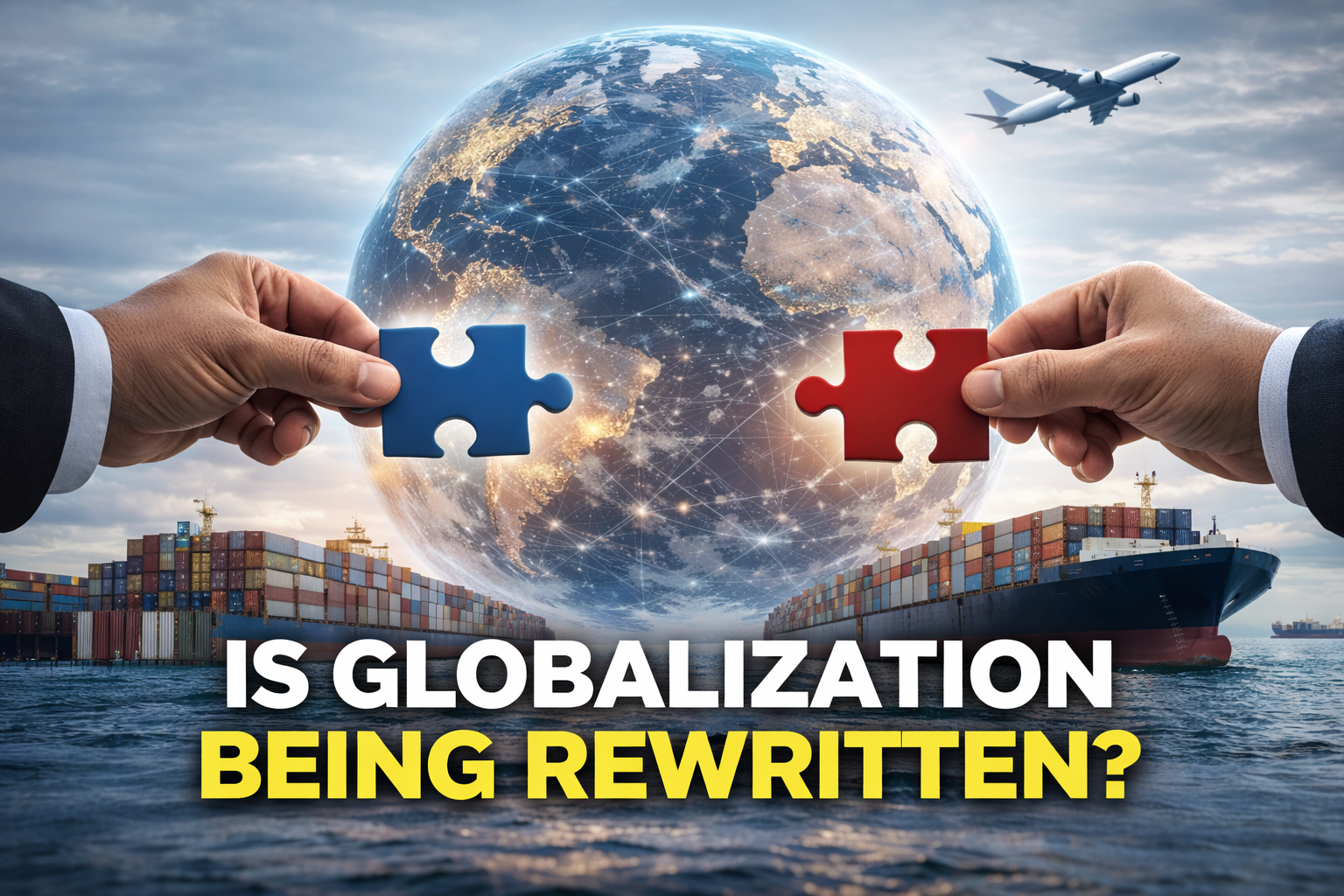
For decades, globalization felt like a one way street. Goods, money, ideas, and people flowed across borders at increasing speed, knitting the world into a tightly connected economic and cultural web. Now, however, we see globalization being rewritten as new dynamics emerge. Cheap manufacturing in one country powered consumer booms in another. Supply chains stretched across continents. The idea that the world was becoming smaller shaped business strategies and political thinking alike.
Then came the shocks.
The 2008 financial crisis exposed deep fragilities. The COVID-19 pandemic shut borders and factories overnight. Wars, trade tensions, climate disasters, and rising nationalism followed. Headlines began declaring the end of globalization. Governments talked about reshoring, friend shoring, and self reliance. Companies shortened supply chains. Voters questioned whether globalization had worked for them at all.
But step back for a moment, and a more nuanced picture emerges. Globalization may not be dying. Instead, it appears to be changing form. Less about unfettered flows at any cost, and more about resilience, geopolitics, technology, and values.
So the real question may not be whether globalization is ending, but whether it is being rewritten.
From Hyper Globalization to Strategic Globalization
The globalization of the 1990s and early 2000s was built on a simple assumption. Efficiency beats everything. Companies optimized for the lowest cost, wherever it could be found. Governments lowered trade barriers, assuming that economic integration would naturally lead to stability and shared prosperity.
That model delivered cheaper products and lifted millions out of poverty, especially in emerging economies. But it also created hidden vulnerabilities. Supply chains became so lean that a single disruption, such as a closed port, a missing semiconductor, or a geopolitical conflict, could ripple across the world.
What we are seeing now is not a mass retreat behind national borders, but a shift from hyper efficiency to strategic resilience.
Countries still trade. Companies still operate globally. But decisions are increasingly shaped by questions like these. Can we trust this supplier during a crisis? Is this technology too strategically important to depend on one country? What happens if politics suddenly intervenes?
In other words, globalization is becoming more selective.
The Rise of Friend Shoring and Regional Blocs
One of the clearest signs of globalization’s rewrite is the rise of friend shoring. Instead of sourcing purely based on cost, companies and governments prefer partners that share political alignment, regulatory standards, or strategic interests.
We are seeing more regional clusters emerge.
North America is strengthening supply chains within the United States, Canada, and Mexico.
Europe is pushing for strategic autonomy in energy, defense, and technology.
Asia is seeing tighter integration within ASEAN, alongside shifts away from over dependence on a single manufacturing hub.
This does not mean trade is shrinking dramatically. It means trade patterns are being rearranged. Some countries lose prominence, while others gain it. Globalization becomes less universal and more bloc based.
The world remains interconnected, but not evenly or neutrally so.
Technology Is Globalizing Differently Than Goods
While physical supply chains face friction, digital globalization is accelerating.
Data flows now contribute more to global economic growth than trade in goods. A startup in India can serve clients in Europe. A designer in Africa can sell globally through digital platforms. Cloud computing, artificial intelligence tools, and remote work are creating new kinds of cross border integration that do not rely on shipping containers.
At the same time, technology itself has become a battleground. Governments are regulating data flows, scrutinizing foreign tech investments, and racing to dominate areas like semiconductors, artificial intelligence, and green technology.
So even here, globalization is not disappearing. It is becoming more complex. Digital borders are forming alongside physical ones, reshaping how countries connect.
Labor, Inequality, and the Political Backlash
Any discussion of globalization’s future has to confront the social backlash that fueled today’s skepticism.
In many developed economies, globalization coincided with job losses in manufacturing, wage stagnation, and growing inequality. While consumers benefited from lower prices, not everyone shared equally in the gains. The promise that displaced workers would seamlessly transition into new roles often fell short.
This discontent translated into political movements demanding protection, control, and national priority. Tariffs, migration restrictions, and industrial policies followed.
But even here, the story is not simply anti globalization. Many governments are trying to reshape globalization so it aligns better with domestic priorities, protecting workers, ensuring fair competition, and preventing a race to the bottom.
The rewrite is as much political as it is economic.
Climate Change Is Forcing a Rethink
Climate change may be the strongest force pushing globalization toward a new model.
Long distance shipping, carbon intensive manufacturing, and resource extraction come with environmental costs that are harder to ignore. As countries commit to net zero targets, supply chains are being reevaluated not just for cost, but for carbon impact.
This could mean more local or regional production for some goods. But it also means deeper global cooperation on clean energy, climate finance, and green technology transfer.
Ironically, solving climate change may require a different kind of globalization, one focused on shared survival rather than pure profit.
Emerging Economies in a Rewritten Global System
For emerging economies, the rewrite of globalization presents both risks and opportunities.
Countries that benefited from being low cost manufacturing hubs may face pressure as companies diversify locations or automate production. At the same time, nations that offer political stability, skilled labor, and sustainable practices may attract new investment.
Manufacturing is spreading across multiple countries rather than concentrating in just one. Digital services are opening doors for economies that were previously sidelined from global trade.
The new globalization rewards adaptability more than size alone.
Is Globalization Really Being Reversed?
If globalization were truly reversing, we would expect to see collapsing trade volumes, widespread isolation, and shrinking cross border connections. That is not happening.
Trade is growing more slowly, but it is still growing. Capital continues to move across borders. Ideas and culture spread faster than ever through digital channels. International cooperation, though strained, remains essential in areas like health, climate, and security.
What is changing is the logic behind globalization. Efficiency is no longer the only priority. Security, resilience, sustainability, and political alignment now matter just as much.
This is not the end of globalization. It is a rewrite that is uneven, contested, and still unfolding.
The Bigger Picture
The old story of globalization was simple. More openness meant more prosperity. The new story is far more complicated.
Globalization now has to answer tougher questions. Who benefits? Who carries the risks? What happens when global efficiency clashes with national security or social stability?
Different countries will answer these questions in different ways. Some will lean inward, others outward. Most will try to balance both.
What is clear is that the world is not going back to a pre globalization era. The connections are too deep, the challenges too global, and the technologies too embedded.
Globalization is not being undone. It is being renegotiated.
FAQs
Not exactly. While trade growth has slowed and supply chains are being restructured, global trade, investment, and data flows remain strong. The shape of globalization is changing more than its existence.
Reversing globalization would mean closing markets and isolating economies. Rewriting globalization means changing how countries engage, placing resilience, security, and sustainability alongside efficiency.
Recent crises exposed the risks of over dependence on global supply chains. Governments now see trade, technology, and production as strategic and security issues, not just economic ones.
Technology enables new forms of global integration through digital services, remote work, and data flows, even as physical trade faces more barriers. At the same time, technology has become deeply political.
People may see higher prices for some goods, more focus on local jobs, and new opportunities through digital and global work. The outcomes will depend heavily on policy choices and how inclusive the new globalization becomes.