
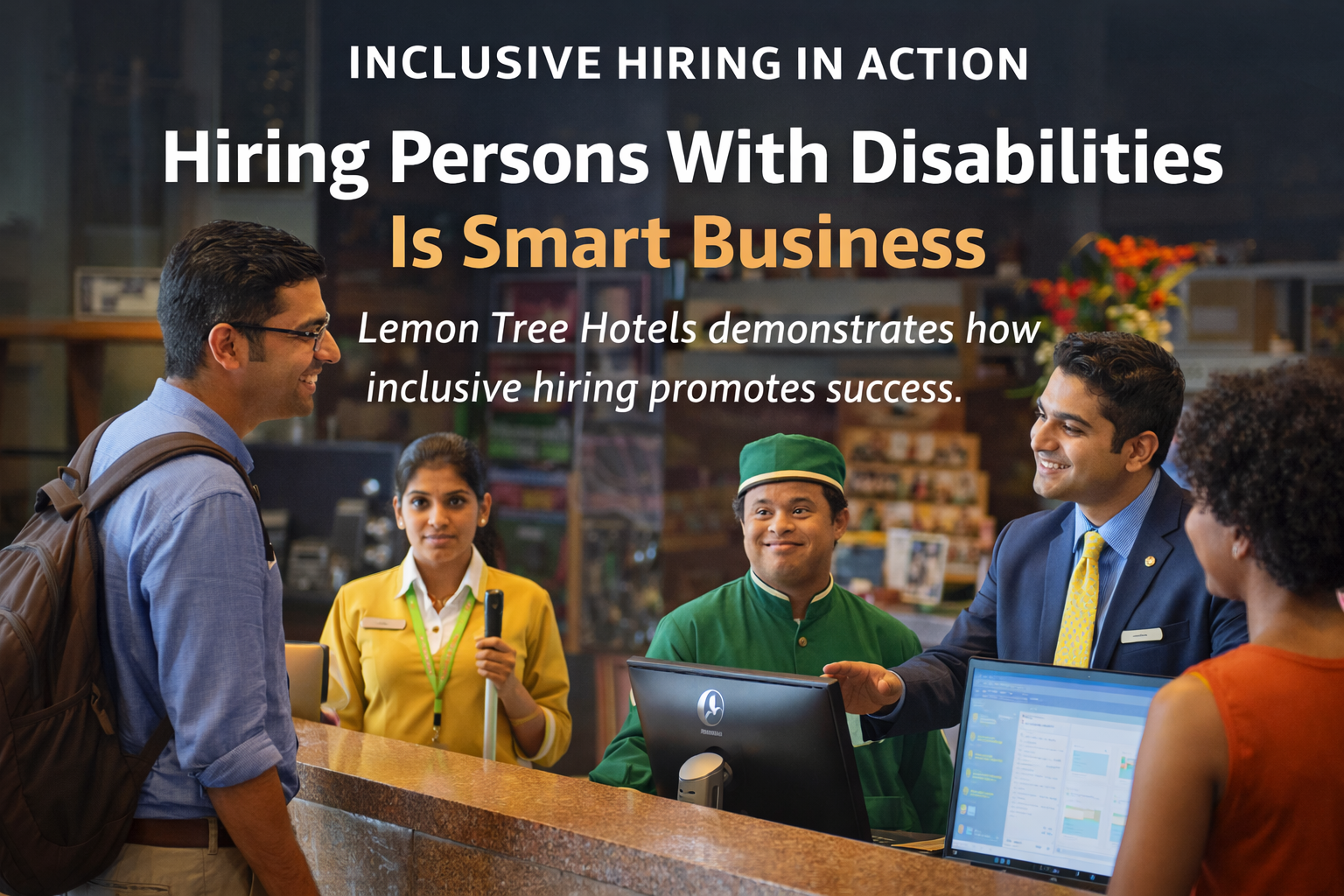
Hiring persons with disabilities is smart business, not charity. That message has gained renewed attention after a viral social media post highlighted Lemon Tree Hotels’ long-standing inclusive hiring strategy.
The post, originally shared by market expert Aditya Kondawar and later reshared by sports producer Joy Bhattacharjya, described how what began as a small internal experiment evolved into a core workforce model at Lemon Tree Hotels. The company’s leadership maintains that inclusion has delivered measurable business outcomes.
Hiring Persons With Disabilities Is Smart Business: The Lemon Tree Approach
The initiative reportedly began with a discussion between the human resources team and Chairman and Managing Director Patu Keswani. The company decided to hire two persons with disabilities as a pilot programme.
Initially, there were concerns about integration, training and performance. However, those doubts eased quickly as the employees adapted effectively to their roles.
Over time, the programme expanded. Today, approximately 13 per cent of Lemon Tree Hotels’ workforce consists of employees with disabilities. In several properties, the share reportedly approaches 20 per cent.
Company representatives have consistently described inclusion as a strategic workforce decision rather than a philanthropic effort.
Lower Attrition and Workforce Stability
One of the most cited metrics from the viral post relates to employee retention. According to data shared online:
- Attrition among employees with disabilities is about 12 per cent
- Industry-wide attrition in hospitality is estimated at nearly 50 per cent
High employee turnover is a known challenge in the hospitality sector. Lower attrition can reduce recruitment and training costs while improving service consistency.
Industry analysts note that stable staffing often leads to better customer experience, operational efficiency and long-term savings.
National Recognition for Inclusive Hiring
Lemon Tree Hotels has received formal recognition for its inclusive employment practices. The company was awarded the National Award for “Best Employer of Persons with Disabilities” in 2011 and 2016 by the President of India.
These awards underscore broader efforts within India to promote equal employment opportunities and workplace accessibility.
Personal Experiences Highlight Impact
Joy Bhattacharjya, in resharing the viral post, added a personal anecdote from his stay at a Lemon Tree property in Bengaluru during a volleyball league event.
He described how a receptionist, who appeared to be on the autism spectrum, would carefully hand him copies of The Times of India and The Economic Times each morning. On one occasion, when he declined one newspaper, the change in routine seemed to cause discomfort. Recognising this, he accepted both copies the following day.
His account concluded with appreciation for the hotel chain’s inclusive environment. The story resonated widely on social media, prompting renewed discussion about disability inclusion in mainstream workplaces.
Why Inclusive Hiring Makes Business Sense
Experts say inclusive hiring strategies can offer tangible advantages:
- Broader talent pools
- Stronger employee loyalty
- Lower attrition rates
- Enhanced workplace culture
- Positive brand perception
Moreover, structured training and accessible workplace design can enable persons with disabilities to perform effectively across operational roles.
In sectors such as hospitality, retail and services, predictable workflows and customer-facing roles can align well with inclusive employment models when supported by appropriate systems.
What This Means
The renewed attention around Lemon Tree Hotels highlights a broader shift in how businesses view diversity. Rather than positioning inclusion as a social responsibility initiative alone, companies increasingly evaluate it through operational and financial metrics.
As labour markets tighten and retention becomes a priority, inclusive hiring may emerge as both a workforce strategy and a competitive differentiator.
Key Takeaways
- Lemon Tree Hotels employs around 13 per cent persons with disabilities across its workforce.
- Attrition among these employees is significantly lower than industry averages.
- The company has received national awards for inclusive employment practices.
- Inclusive hiring is framed as a business strategy rather than charity.
- Social media attention has renewed discussion on disability inclusion in India’s corporate sector.
FAQs
Hiring persons with disabilities can improve retention, reduce recruitment costs and strengthen workplace culture. Lower attrition rates often translate into operational stability and consistent customer service, especially in industries such as hospitality and retail.
According to publicly shared information, approximately 13 per cent of Lemon Tree Hotels’ workforce consists of employees with disabilities. In certain properties, that proportion is reported to be closer to 20 per cent.
Data cited in recent discussions suggests attrition among employees with disabilities at Lemon Tree Hotels is around 12 per cent, compared to hospitality industry averages nearing 50 per cent. Lower turnover can significantly reduce training and hiring expenses.
Yes. Lemon Tree Hotels received the National Award for “Best Employer of Persons with Disabilities” in 2011 and 2016 from the President of India, acknowledging its inclusive employment practices.
Not necessarily. Many companies now integrate inclusive hiring into core business strategies. Beyond social impact, firms often evaluate inclusion through measurable indicators such as productivity, retention and long-term cost efficiency.