


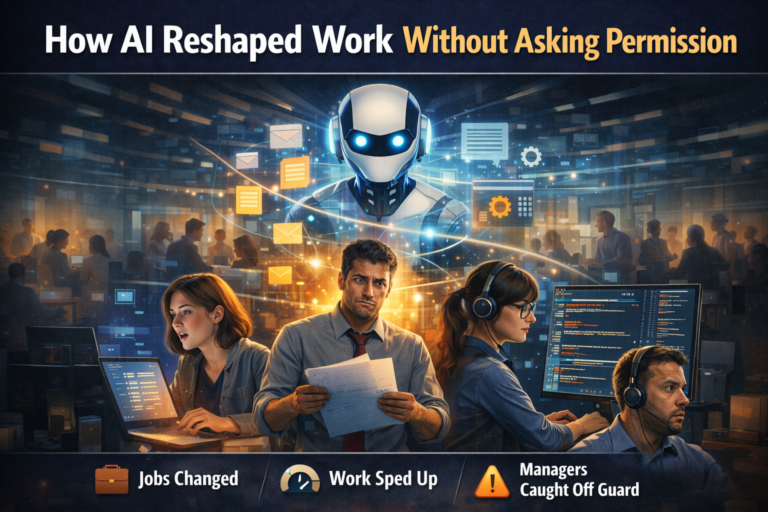
AI didn’t arrive at the office with a rollout plan, a town hall, or a neatly labeled change management deck. It just showed up. One day you were writing emails, crunching numbers, designing slides, or debugging code the same old way. The next day, a tool popped up that could do half of it in seconds.
No vote. No warning. No permission slip.
And somehow, work changed anyway.
The quiet takeover
Unlike past workplace revolutions like the assembly line, the personal computer, or the internet, AI didn’t need new buildings or even new job titles to get started. It slipped into browsers, inboxes, design tools, and spreadsheets. Many workers met AI not through their employer, but through curiosity, urgency, or exhaustion.
“Let me just see if this helps,” became a daily experiment.
Writers used it to draft. Analysts used it to summarize. Developers used it to autocomplete entire functions. Managers used it to prep agendas. Students used it to study. Recruiters used it to screen. Marketers used it to ideate. Support teams used it to respond.
By the time companies started forming AI task forces, employees were already relying on it.
Work sped up and blurred
AI didn’t just make tasks faster. It changed how work feels.
The line between thinking and doing got fuzzy. Drafting no longer meant starting from scratch. Research didn’t always mean digging. It meant asking. Output increased, but so did expectations. If a first draft takes five minutes instead of fifty, what’s the new definition of “done”?
For many workers, AI became a productivity boost and a pressure multiplier. The tools promised relief from busywork, yet quietly raised the bar for speed, volume, and polish.
Efficiency stopped being a competitive edge and became the baseline.
Jobs didn’t disappear. Tasks did.
Despite dramatic headlines, most jobs didn’t vanish overnight. Instead, they quietly shape shifted.
AI chipped away at tasks within roles:
- Entry level writing became more about editing and judgment
- Junior coding focused less on syntax and more on system thinking
- Customer support leaned toward empathy and edge cases
- Knowledge work moved from creation to curation
The result was roles that stretched, skill expectations that widened, and workers who learned how to work with AI pulling ahead of those who avoided it.
Not because they were smarter, but because they adapted sooner.
Managers played catch up
Here’s the uncomfortable truth. Employees adopted AI faster than leadership did.
Many managers first learned their teams were using AI when:
- A report sounded unusually polished
- A turnaround time suddenly shrank
- A process mysteriously improved
That created tension. Was AI allowed? Was it safe? Was it cheating? Was it brilliant?
Organizations scrambled to write policies for behavior that was already happening. Some banned tools. Others quietly reversed course. The smartest ones focused less on restriction and more on guidance, like how to use AI responsibly, transparently, and well.
The real shift from effort to judgment
The deepest change AI brought to work isn’t automation. It’s emphasis.
When machines can generate options instantly, human value shifts to:
- Asking better questions
- Knowing what not to trust
- Spotting nuance, bias, and context
- Making calls when the answer isn’t obvious
AI didn’t replace human work. It exposed what parts of work were truly human all along.
And it did all of this without waiting for approval.
FAQs
Yes. Adoption didn’t require enterprise buy in. Most AI tools were cheap or free, easy to use, and immediately useful. When tools remove friction, change accelerates whether leadership is ready or not.
Mostly changing them. AI automates tasks, not entire roles. But that still matters. When core tasks shift, job definitions, career paths, and skill requirements shift too.
Because individuals feel pain points first. Deadlines, overload, and burnout drive experimentation faster than formal strategy ever could. People used what helped them survive the workday.
Judgment, domain knowledge, critical thinking, communication, and ethical awareness. Knowing how to use AI matters, but knowing when to challenge it matters more.
Not even close. AI tools are still evolving, norms are still forming, and best practices are far from settled. The advantage goes to those who start learning now, not those who started earliest.