


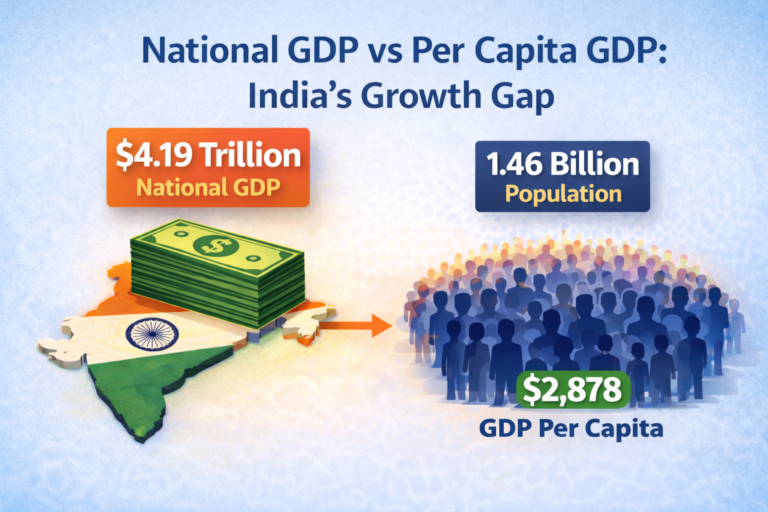
India’s economic rise has drawn global attention. The National GDP vs per capita GDP comparison highlights a central paradox: while India is now the world’s fourth-largest economy with a nominal GDP of $4.19 trillion, the average income per person remains far lower than leading economies.
According to the International Monetary Fund (IMF) World Economic Outlook (April 2025), India ranks behind only the United States, China and Germany in overall economic output. However, GDP per capita figures tell a more restrained story about individual economic well-being.
India’s National GDP vs Per Capita GDP: Understanding the Numbers
As per IMF estimates (April 2025):
- India: $4.19 trillion nominal GDP
- United States: $30.51 trillion
- China: $19.23 trillion
- Germany: $4.74 trillion
Prime Minister Narendra Modi, addressing the India-Japan Economic Forum in Tokyo on August 29, 2025, stated that India is expected to soon become the world’s third-largest economy. Earlier, in May 2025, NITI Aayog CEO B.V.R. Subrahmanyam confirmed India’s fourth-place ranking.
Yet, when adjusted per person:
- India: $2,878 GDP per capita
- United States: $89,105
- Germany: $55,911
- Japan: $33,956
- China: $13,687
India’s global ranking on GDP per capita stands roughly between 135 and 142, according to IMF datasets.
Why Is There Such a Gap?
Population as the Key Factor
India’s population reached approximately 146.39 crore by April 2025, according to United Nations demographic data. GDP measures total economic output. GDP per capita divides that output by the total population.
A larger population significantly lowers the per-person average, even if total production is high.
By contrast, countries like Germany and Japan have smaller populations, which helps raise their per capita figures despite smaller total GDP compared to India.
The Role of Purchasing Power Parity (PPP)
Nominal GDP per capita reflects income converted into U.S. dollars. However, it does not account for cost-of-living differences.
The IMF estimates India’s PPP-adjusted GDP per capita at approximately $12,130 in April 2025. This figure is higher than the nominal value because everyday goods and services cost less in India than in advanced economies.
Still, even after adjusting for purchasing power, India trails behind major economies.
What GDP Measures and What It Does Not
While National GDP reflects economic scale, it does not indicate:
- Income distribution
- Wealth inequality
- Quality of public services
- Employment quality
- Access to healthcare and education
GDP per capita provides a rough average, but it cannot show disparities between urban and rural populations or across income groups.
Economists note that sustained improvements in living standards require gains in productivity, wages and formal employment opportunities.
Economic Outlook: Bridging the Gap
Global institutions such as the IMF and World Bank highlight several pathways to narrow the divide between total growth and individual prosperity:
- Expanding high-skilled employment
- Investing in education and healthcare
- Improving infrastructure
- Boosting manufacturing productivity
- Encouraging formal sector job creation
India’s demographic profile, with a large young workforce, is viewed as a potential advantage. However, converting this into higher per capita income depends on skill development and job absorption.
What This Means
India’s rising National GDP enhances its global economic influence and fiscal capacity. It strengthens investor confidence and geopolitical standing.
However, per capita GDP underscores the domestic challenge: ensuring that growth translates into higher household incomes and broader prosperity.
Key Takeaways
- India is the world’s fourth-largest economy at $4.19 trillion.
- GDP per capita remains comparatively low at $2,878.
- Population size largely explains the gap.
- PPP-adjusted figures improve the picture but do not eliminate disparities.
- Long-term growth must focus on productivity and income expansion.
FAQs
National GDP measures the total value of goods and services produced in a country. GDP per capita divides that total by the population to estimate average economic output per person. The two indicators reflect overall economic size versus individual-level prosperity.
India’s large population lowers its per-person average income. While total economic output is high, dividing it among more than 1.4 billion people reduces the GDP per capita figure compared to smaller, advanced economies.
According to the IMF World Economic Outlook (April 2025), India’s nominal GDP per capita is approximately $2,878. The purchasing power parity (PPP) adjusted figure is estimated at around $12,130.
GDP per capita offers a general indication of average economic resources per person. However, it does not account for income inequality, regional disparities, access to services, or variations in cost of living within the country.
Improving GDP per capita requires sustained growth in productivity, job creation and wages. Structural reforms, education investments and expansion of higher-value industries can gradually raise per-person income over time.