


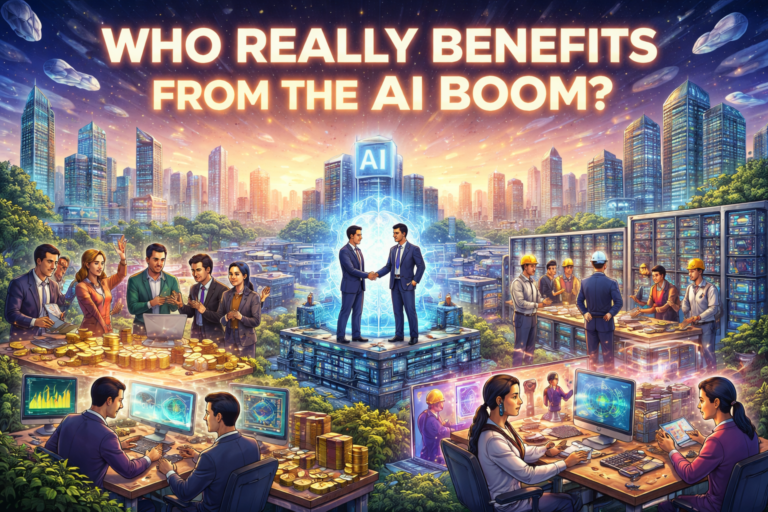
Artificial intelligence is having a moment. Actually, scratch that, it is having a decade.
Everywhere you look, AI is being pitched as the next electricity, the next internet, the next thing that will change everything. Startups promise productivity miracles. Big tech firms report eye-watering investments. Governments talk about national AI strategies as if they are arms races. And somewhere in the middle of all this hype, most people are quietly wondering: okay, but who is actually winning here?
The short answer is that a small group is benefiting enormously, a larger group is benefiting unevenly, and a lot of people are still waiting to see whether AI will help or hurt them.
Let’s unpack that, without the buzzwords.
The Big Winners: Tech Giants and Chipmakers
If you are looking for clear, undeniable winners of the AI boom, start with the companies building the infrastructure.
Training and running modern AI models takes staggering amounts of computing power. That has turned advanced chips, especially GPUs, into the new oil. Companies that design or manufacture these chips have seen explosive growth, soaring valuations, and unprecedented demand. Their products are so essential that entire AI strategies can hinge on access to them.
Then there are the big tech firms that already own massive cloud platforms, oceans of data, and global distribution. AI did not disrupt their power. It reinforced it. When you already have billions of users, AI becomes a force multiplier through better recommendations, stickier products, more automation, and lower costs.
In other words, AI rewards scale. And the biggest players already had plenty of it.
Investors: Riding the Hype Wave
Venture capital firms and institutional investors are another clear beneficiary, at least for now.
AI has become the hottest pitch deck keyword since “dot-com.” Billions are flowing into AI startups, often at dizzying valuations and at earlier stages than usual. For investors, this is a familiar pattern: place lots of bets, expect many failures, and hope a few turn into generational companies.
Public markets are playing along too. Simply mentioning AI in earnings calls has been shown to boost stock prices. Whether that enthusiasm is fully justified is another question, but in the short term, capital has been rewarded for chasing the AI narrative.
Of course, hype cuts both ways. If expectations outpace reality, some of these gains may prove fragile.
Highly Skilled Workers: Productivity on Steroids
For certain professionals, AI feels like a superpower.
Software developers use AI tools to write boilerplate code in seconds. Designers generate concepts instantly. Researchers summarize papers in minutes instead of days. Lawyers, consultants, and analysts automate repetitive tasks that once ate up their evenings.
The result is that people who already had valuable skills can now do more, faster. In many cases, that makes them even more valuable to employers, or frees them to work independently.
But there is a catch. AI tends to amplify existing advantages. Those who know how to ask the right questions, verify outputs, and integrate AI into their workflows pull further ahead. Those without that foundation may struggle to keep up.
Companies: Lower Costs, Higher Expectations
From a corporate perspective, AI is irresistible.
Customer service chatbots reduce staffing costs. Predictive systems optimize supply chains. Marketing teams personalize campaigns at scale. Executives see AI as a way to boost efficiency without increasing headcount, which is a tempting proposition in uncertain economic times.
But this benefit comes with pressure. Once AI tools become standard, not using them looks like inefficiency. Workers are expected to be faster, more productive, and available across more channels. In some cases, AI does not reduce workload. It raises the bar.
So while companies gain flexibility and margins, employees do not always see those gains translated into better pay or shorter hours.
Workers at Risk: Automation’s Uneven Impact
Here is where the story gets uncomfortable.
AI does not just enhance work. It replaces parts of it. Tasks that are routine, predictable, or heavily text- or image-based are especially vulnerable. Entry-level roles, administrative jobs, content moderation, basic translation, and some forms of creative work are already feeling the squeeze.
Historically, technology creates new jobs as it destroys old ones. The problem is timing and distribution. New AI-related jobs often require specialized skills, while displaced workers may not have easy pathways to retrain. The benefits arrive quickly. The adjustments take years.
If history is any guide, the workers most affected will be those with the least bargaining power and the least cushion to absorb disruption.
Consumers: Convenience With a Price
For everyday users, AI’s benefits are subtle but real.
Search gets faster. Recommendations get better. Digital assistants feel more helpful. Photo apps clean up images effortlessly. Many of these tools are free, or bundled into services people already use.
But consumers also pay in less obvious ways. AI systems thrive on data, and that data often comes from users. Privacy trade-offs, opaque algorithms, and increased surveillance are part of the deal, even if they are buried in terms and conditions.
So yes, consumers benefit, but not without costs that are hard to measure or opt out of.
Society at Large: The Unsettled Question
Zooming out, the biggest question is not who benefits now, but who benefits long-term.
AI has the potential to increase overall productivity and wealth dramatically. The risk is that those gains concentrate in the hands of a few, namely companies, investors, and countries with early advantages, while everyone else sees slower wage growth and greater job insecurity.
Without deliberate choices about education, regulation, competition, and social safety nets, the AI boom could widen existing inequalities rather than reduce them.
Technology does not decide who wins. Policy, power, and priorities do.
So, Who Really Benefits?
Right now:
• Big tech companies
• Chipmakers and infrastructure providers
• Investors
• Highly skilled, AI-literate workers
Potentially, but not guaranteed:
• Consumers
• Businesses that adapt responsibly
• Society as a whole
The AI boom is not a rising tide lifting all boats, at least not automatically. It is more like a powerful engine. Where it takes us depends on who is steering, who is invited aboard, and who is left standing on the platform.
FAQs
AI is more likely to change jobs than eliminate them entirely, but some roles will disappear. Jobs made up of routine, predictable tasks face the highest risk. Learning how to work with AI can significantly reduce that risk.
At the moment, yes. The biggest gains are concentrated among large firms, investors, and highly skilled workers. Without intervention, that concentration is likely to continue.
Absolutely. Investments in education, reskilling programs, competition policy, data protection, and worker protections all shape how AI’s benefits are distributed.
Some are, but many depend on infrastructure owned by big tech firms. That creates a power imbalance that can limit true competition unless regulated carefully.
Parts of it might be. The technology is real and transformative, but hype-driven valuations and unrealistic expectations could lead to corrections. Long-term impact is likely, even if short-term excitement cools.