
Artificial intelligence has transformed how people search for information online. Instead of relying solely on traditional search engines, millions of users now ask AI assistants like ChatGPT, Google AI Mode, Gemini, Claude, and Perplexity for recommendations, product comparisons, and business advice. As a result, brands are no longer competing only for Google’s first page they’re competing to become the answer AI provides.
In 2026, tracking your brand’s AI visibility has become as important as monitoring your SEO rankings. If your business isn’t appearing in AI-generated responses, you’re missing a growing source of traffic, awareness, and customer trust.
This guide explains how businesses can measure, improve, and maintain their AI visibility.
What Is AI Visibility?
AI visibility refers to how frequently and accurately your brand appears in responses generated by AI-powered search engines and assistants.
For example, if someone asks:
- “What are the best CRM software companies?”
- “Top digital marketing agencies in Dubai”
- “Best project management tools for startups”
Does your brand appear in the recommendations?
If the answer is no, your competitors are gaining exposure where future customers are searching.
Unlike traditional SEO, AI visibility focuses on being cited, summarized, recommended, or referenced by language models.
Why AI Visibility Matters in 2026
Consumer behavior has changed significantly over the past few years.
Instead of browsing multiple websites, users increasingly expect AI assistants to summarize information and recommend trusted brands instantly.
This shift means businesses must optimize not only for search engine rankings but also for AI-generated recommendations.
Brands that consistently appear in AI responses often experience:
- Higher brand awareness
- Increased trust and authority
- Better referral traffic
- More qualified leads
- Greater visibility across multiple AI platforms
For many industries, AI visibility has become a new digital marketing metric alongside rankings, impressions, and conversions.
Key AI Platforms to Monitor
Your brand should monitor visibility across multiple AI platforms rather than relying on a single service.
Some of the most influential AI assistants include:
- ChatGPT
- Google AI Mode
- Google AI Overviews
- Google Gemini
- Claude
- Perplexity AI
- Microsoft Copilot
- Meta AI
Each platform uses different retrieval systems, ranking signals, and sources of information.
Appearing consistently across several AI assistants indicates strong overall digital authority.
Metrics That Actually Matter
Tracking AI visibility goes beyond simply asking an AI if it knows your company.
Instead, businesses should measure meaningful performance indicators.
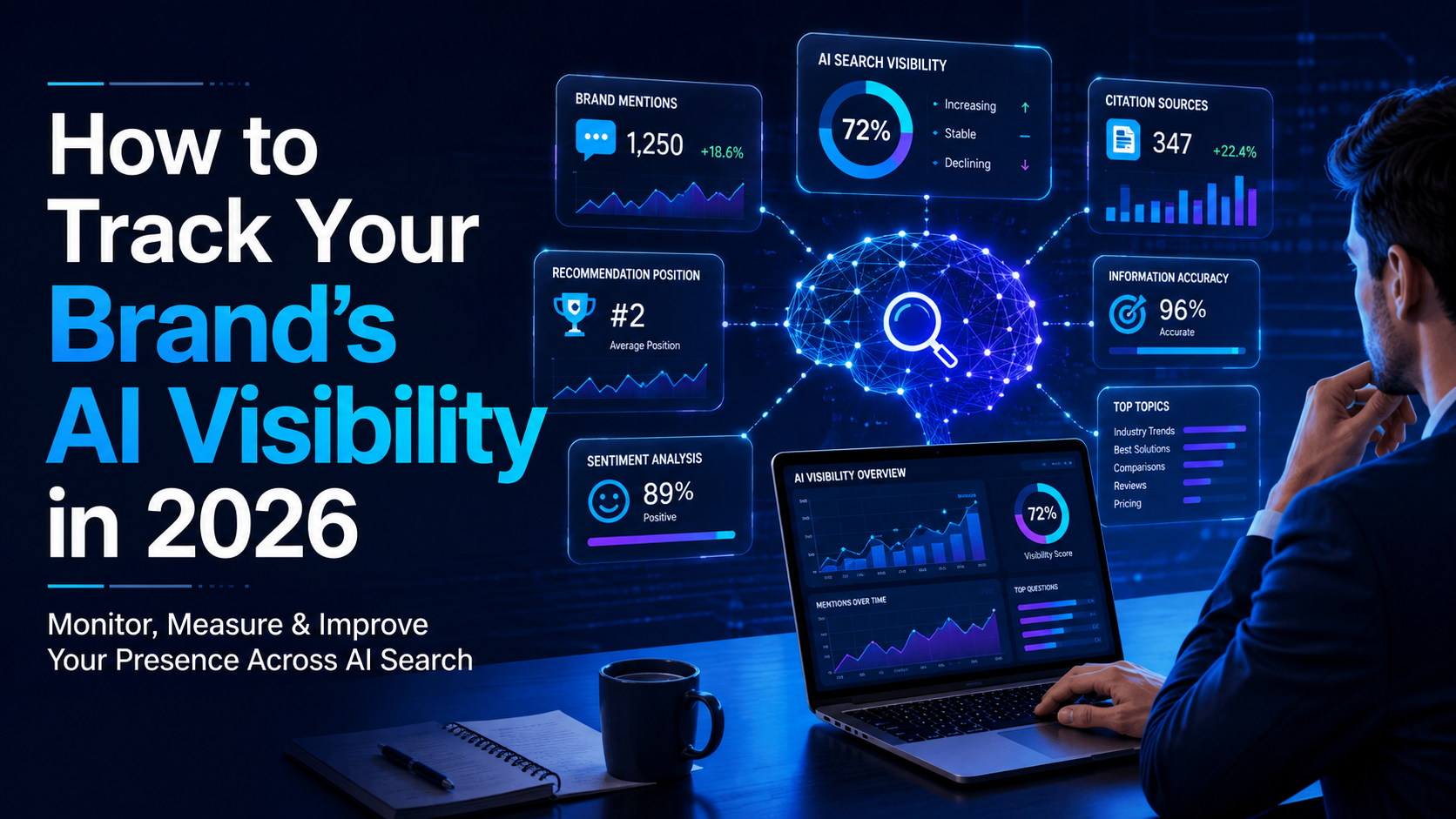
1. Brand Mentions
Track how often AI assistants mention your company when users ask industry-related questions.
For example:
- Best SaaS tools
- Top accounting software
- Leading fintech startups
Record whether your brand appears naturally.
2. Citation Frequency
Some AI systems cite their sources.
Monitor:
- News publications
- Industry blogs
- Company websites
- Research papers
- Knowledge databases
The more frequently authoritative sources mention your business, the greater the chance AI systems will reference your brand.
3. Recommendation Position
If an AI recommends five companies, where does your brand appear?
Being the first recommendation generally provides greater visibility than appearing fifth.
Track your average recommendation position over time.
4. Sentiment Analysis
Visibility alone isn’t enough.
Monitor whether AI describes your company positively, neutrally, or negatively.
Look for recurring themes such as:
- Innovation
- Customer service
- Pricing
- Product quality
- Industry leadership
Consistent positive descriptions strengthen brand perception.
5. Information Accuracy
AI occasionally presents outdated or incomplete information.
Regularly verify that details such as:
- Company name
- Founder
- Headquarters
- Products
- Services
- Website
- Contact information
are represented correctly across AI-generated responses.
How to Measure AI Visibility
Create a Prompt Library
Develop a list of prompts that potential customers might ask.
Examples include:
- Best cybersecurity companies
- Top PR agencies
- Best startup media platforms
- Affordable accounting software
- Best CRM for small businesses
Run these prompts monthly across major AI platforms.
Document:
- Whether your brand appears
- Ranking position
- Description quality
- Source references
This creates a benchmark for long-term tracking.
Monitor Brand Mentions
Use social listening and media monitoring tools alongside AI monitoring.
Track mentions from:
- News websites
- Business directories
- Industry publications
- Blogs
- Podcasts
- Research reports
AI models often rely on authoritative public information.
Review Knowledge Panels
Ensure your business information remains consistent across:
- Company website
- Crunchbase
- Wikipedia (if applicable)
- Google Business Profile
- Industry directories
Consistent information improves digital trust signals.
Build an AI Visibility Dashboard
Many marketing teams now include AI visibility in their monthly reporting.
A practical dashboard may include:
| Metric | Goal |
|---|---|
| AI Brand Mentions | Increase month-over-month |
| Recommendation Position | Top 3 |
| Positive Sentiment | Above 90% |
| Source Citations | Growing monthly |
| Prompt Coverage | Expand every quarter |
| Information Accuracy | 100% |
Tracking these metrics helps identify trends and prioritize improvements.
Improve Your AI Visibility
If your brand rarely appears in AI-generated responses, focus on building authority rather than trying to manipulate AI systems.
Effective strategies include:
Publish Expert Content
Create in-depth articles that answer real customer questions.
Long-form educational content often becomes a trusted source for AI systems.
Earn High-Quality Media Coverage
Mentions in respected news publications, industry magazines, and reputable blogs strengthen your brand’s authority.
Quality matters far more than quantity.
Maintain Consistent Brand Information
Ensure your company details remain identical across:
- Website
- Social media
- Business listings
- Press releases
- Author profiles
Consistency reduces confusion for both search engines and AI systems.
Strengthen Your Expertise
Publish:
- Original research
- Industry reports
- Surveys
- Case studies
- Whitepapers
Unique data makes your content more likely to be referenced by AI assistants.
Improve Technical SEO
AI visibility still depends on strong technical foundations.
Focus on:
- Fast website speed
- Mobile optimization
- Structured data
- Internal linking
- Clear page hierarchy
- Descriptive headings
These improvements make content easier for search engines and AI retrieval systems to understand.
Common Mistakes to Avoid
Many businesses still approach AI visibility incorrectly.
Avoid these mistakes:
- Measuring only Google rankings
- Publishing thin AI-generated content without human expertise
- Ignoring brand consistency
- Neglecting authoritative backlinks
- Failing to update outdated company information
- Tracking only one AI platform
AI visibility requires a broader strategy than traditional SEO.
The Future of AI Brand Visibility
As AI assistants become a primary way people discover businesses, brands will increasingly compete for inclusion in AI-generated recommendations rather than only search engine rankings.
Future success will depend on producing trustworthy, expert-led content, maintaining consistent digital identities, and earning recognition from authoritative sources. Companies that monitor AI visibility today will be better prepared for the evolving search landscape and more likely to remain discoverable as AI continues to shape how consumers find information.
Overview
Tracking your brand’s AI visibility in 2026 is no longer optional, it’s an essential part of digital marketing. By monitoring brand mentions, recommendation rankings, citation sources, sentiment, and information accuracy across multiple AI platforms, businesses can better understand how they are represented in AI-generated responses.
The brands that invest in credibility, expertise, and consistent online information today will have a stronger chance of becoming the trusted answers AI systems recommend tomorrow.